|
|
Microscope Museum Collection of antique microscopes and other
scientific instruments |
|
|
|
|
|
Microscope
549B (replica of an Antoni
van Leeuwenhoek microscope, made by Museum Boerhaave)
Microscope
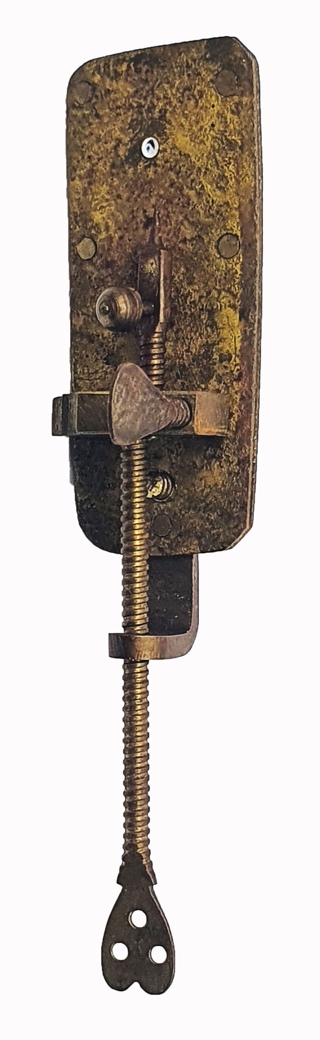
549B is a replica of an Antoni van Leeuwenhoek microscope, made of brass. The
replica is engraved on one side with “COPIE LEIDEN”, and was hand-made by the
Museum Boerhaave, Leiden, Netherlands, probably in the 1980s (and is
identical to a real Van Leeuwenhoek’s microscope model owned by the museum).
This type of replica was made by Museum Boerhaave since 1960 until the 2010s
by Arie de Vink, a former restorer/conservator of the museum (see here),
and copies are owned and exhibited by several museums around the world. The
museum still manufactures and sells replicas but, since 2011, these replicas
are based on a slightly different Van Leuwenhoek’s microscope model also
owned by the museum. The replica came with fine bespoke plexiglass display
case engraved with “SMITHSONIAN INSTITUTION”. This type of microscope is the
“standard” Van Leeuwenhoek microscope, and widely illustrated in books,
textbooks, webpages and other sources on biology, microbiology, microscopy,
and other subjects. Figure 1 shows a drawing of one of these microscopes,
made by the English microscopist John Mayal in 1886, based on an original
Leeuwenhoek microscope that belonged to the Zoological Laboratories at the
University of Utrecht. Antoni van Leeuwenhoek (1632 - 1723) was a Dutch
microscopist who was the first to observe bacteria and protozoa, and is many
times referred to as the father of microbiology. Van Leeuwenhoek made
microscopes consisting of a single high-quality lens of very short focal
length. At the time, such simple microscopes were preferable to the compound
microscope, which increased the problem of chromatic aberration. Van
Leeuwenhoek’s methods of microscopy remain something of a mystery. During his
lifetime he made more than 500 lenses, most of which were very small (no
larger than a pinhead) and usually mounted them between two thin brass
plates, riveted together. A large sample of those lenses were found to have
magnifying powers in the range of 50 to, at the most, 300 times. Van
Leeuwenhoek made more than 270 single-lens microscopes, and most of these
were listed in the 1747 auction catalogue when all his little lenses and
microscopes were sold after the death of Van Leeuwenhoek’s daughter Maria,
and 24 years after Van Leeuwenhoek’s death. Three of these microscopes were
known to be made of gold, but the majority were made of silver or brass. Most
microscopes were lost through the times and, today, only eleven microscopes
are known and recognised as original Van Leeuwenhoek microscopes and
exhibited in several museums such as the Boerhaave Museum in Leiden. Van
Leeuwenhoek made and used other types of microscopes to observe and study
different types of samples, including dual- and three-lenses microscopes and eel/fish
viewers. Figure 2 below shows a selection of replicas of these microscopes
making part of this collection.
Figure
1.
Drawing of an original Van Leeuwenhoek’s microscope (adapted from “Mayall
J. 1886. Leeuwenhoek’s Microscopes. Journal of the Royal Microscopical
Society 6: 1047 – 1049”).
Figure
2.
Replicas of different types of microscopes associated with Antoni van
Leeuwenhoek: (A) Standard type of single-lens
microscope; (B) Dual lenses microscope; (C) Three-lenses microscope; (D) Aquatic/eel
viewer microscope; (E) Eel viewer/showcase for
visitors microscope; and (F) Fish viewer
microscope. ·
Replica
Van Leeuwenhoek microscope (https://museumboerhaave.wordpress.com/2011/07/29/replica-van-leeuwenhoek-microscope-english-version/) ·
The
Microscope of Antoni van Leeuwenhoek (Boerhaave Museum Replica) (https://microscope-antiques.com/vlleiden.html) ·
National
Museum of American History (https://americanhistory.si.edu/collections/object/nmah_1367039) ·
Replica
Van Leeuwenhoek microscope (https://collection.sciencemuseumgroup.org.uk/objects/co146226/replica-van-leeuwenhoek-microscope) |